chicken mcnugget theorem
弗罗贝尼乌斯数基础定义
给定若干正整数硬币面值,能精确凑出的金额 = 面值的非负整数线性组合;
满足两个前提:
- 若所有面值的最大公约数 \(\gcd>1\):有无穷多金额无法凑出,不存在 “最大不能凑出的数”;
- 若 \(\gcd=1\):仅有有限个金额无法凑出,其中最大的那个数字叫做弗罗贝尼乌斯数
仅 2 个互质面值:有通用公式。设两数 \(a,b\) 互质,最大不可表示数为 \(ab-a-b\);
3 个及以上互质面值:没有通用代数计算公式,只能用「同余分类法」或「筛法动态规划」枚举寻找答案。
Q1 2023 AMC 12B Problems/Problem 16
In the state of Coinland, coins have values  and
and  cents. Suppose
  is the value in cents of the most expensive item in Coinland that cannot be purchased using these coins with exact change. What is the sum of the digits of

Q2 2015 AMC 10B Problems/Problem 15
The town of Hamlet has  people for each horse,
  sheep for each cow, and ducks for each person. Which of the following could not possibly be the total number of people, horses, sheep, cows, and ducks in Hamlet?

Q3 2019 AIME II Problems/Problem 14
Find the sum of all positive integers  such that, given an unlimited supply of stamps of denominations
  and
and  cents,
  cents is the greatest postage that cannot be formed.
Q4 1994 AIME Problems/Problem 11
Ninety-four bricks, each measuring  are to be stacked one on top of another to form a tower 94 bricks tall. Each brick can be oriented so it contributes
  or
or  or
or  to the total height of the tower. How many different tower heights can be achieved using all of the ninety-four bricks?
Q5 1995 AIME Problems/Problem 10
What is the largest positive integer that is not the sum of a positive integral multiple of  and a positive composite integer?
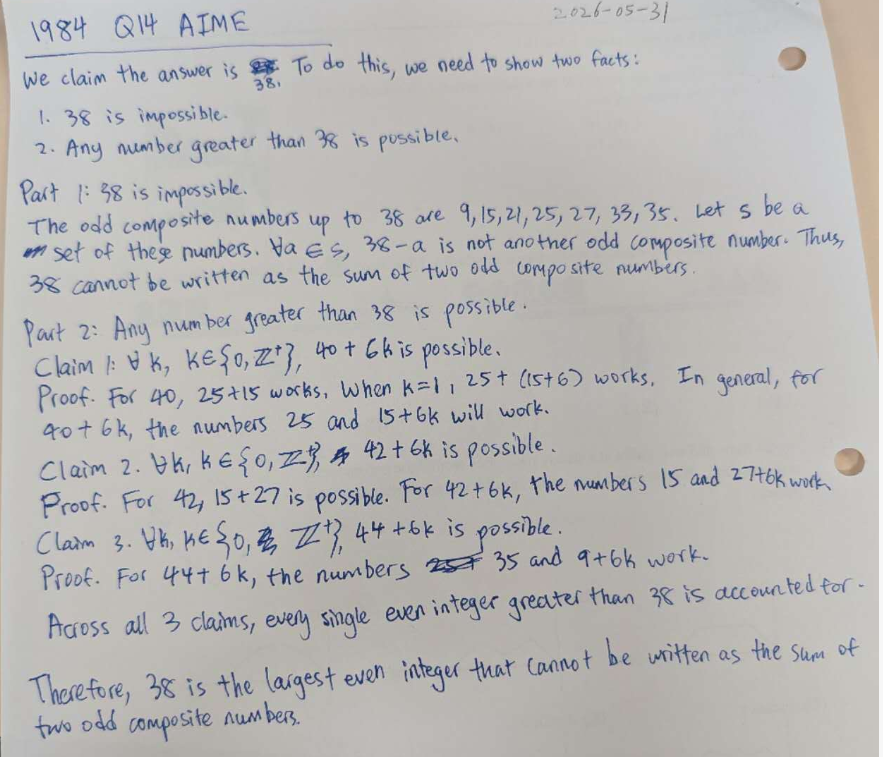
Q6 1984 AIME Problems/Problem 14
What is the largest even integer that cannot be written as the sum of two odd composite numbers?
Q7 2022 AIME II Problems/Problem 14
For positive integers  ,
,  , and
, and  with
with  , consider collections of postage stamps in denominations , , and cents that contain at least one stamp of each denomination. If there exists such a collection that contains sub-collections worth every whole number of cents up to
  cents, let
  be the minimum number of stamps in such a collection. Find the sum of the three least values of such that
  for some choice of and .
Q1
一、整体定性:这份解答就是三元硬币问题标准解法 ——模最小面值剩余分类法
这是处理 3 个及以上面值弗罗贝尼乌斯数的通用套路,完全契合这道 6、10、15 分硬币题,下面分层拆解每一处逻辑、表格、计算原理。
核心底层原理(先读懂这个,全程通透)
硬币面值:6(最小)、10、15。
任意金额 k 除以 6 只会产生 6 种余数:\(0,1,2,3,4,5\)。
关键性质:
如果某个金额 M 能被凑出,那么 \(M+6、M+12、M+18……\) 全部都能凑出,只需要额外增加对应数量的 6 分硬币。
推论:
对任意一个余数 r(比如余 5),找到能凑出的最小数字 \(m_r\) 满足 \(m_r \equiv r \pmod6\);
那么所有大于 \(m_r\)、同余 r 的数都能凑,这个余数类别里最大凑不出的数 = \(m_r – 6\)。
我们把 6 个余数类别各自最大凑不出的数字全部算出来,其中数值最大的那个,就是全局最大无法凑出的金额 x。
二、解析文中的模 6 对照表
先计算每个面值模 6 的余数: \(\begin{align*} 6 \pmod6 &= 0 \\ 10 \pmod6 &= 4 \\ 15 \pmod6 &= 3 \end{align*}\)
表格含义:只用 1 枚硬币、2 枚 10 分硬币时的模 6 余数
- 1 枚硬币:6 余 0,10 余 4,15 余 3
- 2 枚 10 分:\(10\times2=20,\ 20\pmod6=2\)
这张表是快速拼凑目标余数的工具:只用 10、15 组合,搭配出余数 0~5。
三、逐类拆解 6 个剩余类的完整推理
1. 余数 \(0 \pmod6\)
数字:6,12,18,24……
直接只用 6 分硬币即可凑出,这个余数类不存在凑不出的数字,无需记录。
2. 余数 \(1 \pmod6\)
目标:用若干 10、15 凑出一个数,除以 6 余 1。
试 \(b=1\)(1 个 10 分),\(c=1\)(1 个 15 分):
总和 \(10+15=25\),\(25\div6=4\cdots\cdots1\),满足 \(25\equiv1\pmod6\)。
25 是这个余数下最小可凑数。
该余数类最大无法凑出数:\(25-6=19\)。
含义:所有大于 19、除以 6 余 1 的数(31,37,43…)都能凑;1,7,13,19 无法凑。
3. 余数 \(2 \pmod6\)
目标:凑出除以 6 余 2 的最小数。
2 枚 10 分:\(10\times2=20\),\(20\equiv2\pmod6\)。
最小可凑数 \(m_r=20\)。
该余数类最大无法凑出数:\(20-6=14\)。
4. 余数 \(3 \pmod6\)
目标:凑出除以 6 余 3 的最小数。
1 枚 15 分:\(15\equiv3\pmod6\)。
最小可凑数 \(m_r=15\)。
该余数类最大无法凑出数:\(15-6=9\)。
5. 余数 \(4 \pmod6\)
目标:凑出除以 6 余 4 的最小数。
1 枚 10 分:\(10\equiv4\pmod6\)。
最小可凑数 \(m_r=10\)。
该余数类最大无法凑出数:\(10-6=4\)。
6. 余数 \(5 \pmod6\)
目标:凑出除以 6 余 5 的最小数。
2 枚 10 分 + 1 枚 15 分:\(10\times2+15=35\),\(35\div6=5\cdots\cdots5\),\(35\equiv5\pmod6\)。
最小可凑数 \(m_r=35\)。
该余数类最大无法凑出数:\(35-6=29\)。
四、汇总所有余数类的 “最大不可凑数”
余 1:19;余 2:14;余 3:9;余 4:4;余 5:29
这一组数字里最大值是 \(\boldsymbol{29}\),也就是题目所求 \(x=29\)。
五、最后一步:求数字之和
\(2+9=11\)
对应选项 \(\textbf{D}\)。
六、补充验证(检验解法正确性)
- 证明 29 确实无法凑出:方程 \(6a+10b+15c=29\)
- \(c=0\):\(6a+10b=29\),左边偶数,右边奇数,无解;
- \(c=1\):\(6a+10b=14 \Rightarrow 3a+5b=7\),无自然数解;
- \(c\ge2\):\(15\times2=30>29\),不用讨论;因此 29 完全无法凑出。
- 证明 30 及以上全部可以凑出:30 (余 0)、31 (余 1)、32 (余 2)、33 (余 3)、34 (余 4)、35 (余 5),6 个连续整数全部可凑。根据核心性质,每个数字加 6 依然可凑,因此所有≥30 的金额都能精确兑换,29 是最大无法兑换的金额。
七、方法总结
- 适用场景:3 种及以上互质面值硬币(无通用代数公式);
- 操作步骤:① 选取最小面值作为模数,划分全部余数类别;② 对每个余数,找到仅用其他面值组合出的最小同余数;③ 每个余数类最大不可凑数 = 最小同余数 − 模数;④ 取所有余数类结果的最大值,就是弗罗贝尼乌斯数;
- 考察知识点:不定方程、模运算、弗罗贝尼乌斯硬币问题。
Q2 B47
Q3 71
Q4 465
Q5 215
Q6 038
Q7 188
Q8

Leave a Reply
You must be logged in to post a comment.