- Idempotent laws:
- Commutative laws:
- Associative laws:
- Distributive laws:
- De Morgan’s laws:
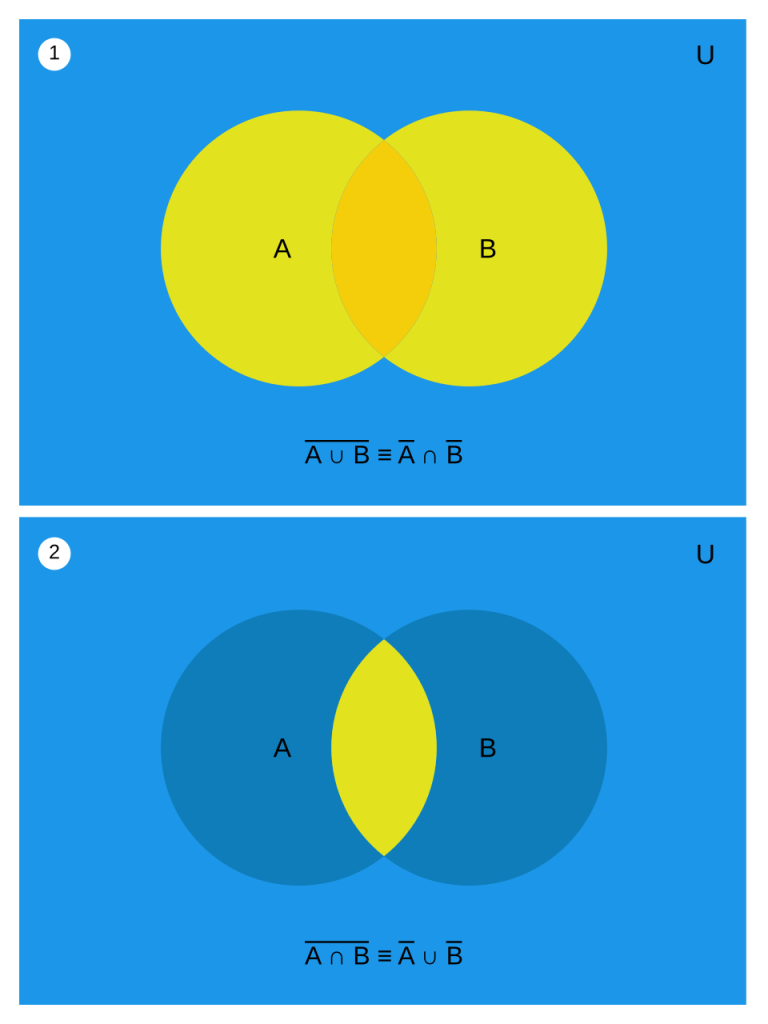
In set theory, it is often stated as “union and intersection interchange under complementation”,[5] which can be formally expressed as:
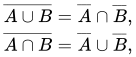
where:
- is the negation of , the overline being written above the terms to be negated,
- is the intersection operator (AND),
- is the union operator (OR).
例1:第一定律 A∪B=A∩B
- 全集:U={1,2,3,4,5,6,7,8,9,10}
- A={2,4,6,8,10} (偶数)
- B={3,6,9} (3的倍数)
左侧计算 A∪B‾A∪B:
- A∪B={2,3,4,6,8,9,10}
- A∪B=U∖(A∪B)={1,5,7}
右侧计算 A‾∩B‾A∩B:
- A={1,3,5,7,9} (奇数)
- B={1,2,4,5,7,8,10} (非3的倍数)
- A∩B={1,5,7}
✅ 两侧相等:{1,5,7}={1,5,7}
直观理解:既不是偶数 也不是 3的倍数 → 只能是 1, 5, 7
例2:第二定律 A∩B=A∪B
使用相同集合:
- A∩B={6} (既是偶数又是3的倍数)
- A∩B=U∖{6}={1,2,3,4,5,7,8,9,10}
右侧:
- A={1,3,5,7,9}
- B={1,2,4,5,7,8,10}
- A∪B={1,2,3,4,5,7,8,9,10}
✅ 两侧相等
直观理解:不是”既是偶数又是3的倍数” → 只要不是偶数 或 不是3的倍数 即可(6是唯一同时满足两者的数,排除它即可)
三、日常生活实例(增强理解)
场景:班级学生兴趣调查
- 全集 U:某班40名学生
- A:喜欢篮球的学生(25人)
- B:喜欢足球的学生(20人)
- A∩B:两项都喜欢(10人)
第一定律应用:
问题:既不喜欢篮球 也不喜欢 足球的学生有哪些?
- 左侧:A∪B = 不在”喜欢篮球或足球”集合中的人
- 右侧:A∩B = 不喜欢篮球 且 不喜欢足球的人
- 结果:40−(25+20−10)=5 人
✅ 两种表述等价:“不喜欢任一项” = “两项都不喜欢”
第二定律应用:
问题:不是”既喜欢篮球又喜欢足球”的学生有哪些?
- 左侧:A∩B = 排除那10个两项都喜欢的学生 → 30人
- 右侧:A∪B = 不喜欢篮球 或 不喜欢足球的人
- 不喜欢篮球:15人
- 不喜欢足球:20人
- 但有5人两项都不喜欢(重复计数)
- 总计:15+20−5=30 人
- ✅ 两侧相等
💡 关键洞察:“不是两者都” ≠ “两者都不是”
- “不是两者都” = 至少有一项不喜欢(30人)← 第二定律
- “两者都不是” = 两项都不喜欢(5人)← 第一定律
Leave a Reply
You must be logged in to post a comment.